
An electronic document and records management system (EDRMS) can help organizations find reliable information, protect sensitive records and demonstrate how decisions were made. Those results depend on much more than installation. When processes remain unclear, metadata is inconsistent and employees keep working outside the system, a technically operational platform can still fall short of its business objectives. For organizations in Mexico, Central America and South America, six implementation priorities can help turn that investment into lasting value.
1. Translate local requirements into system controls
Begin with the obligations that apply to the organization, its sector and the countries in which it operates. Records, privacy, transparency, tax and employment requirements must inform classification, access, retention and disposition decisions. A configuration used in one country may require substantial changes elsewhere.
Create a requirements register that links each obligation to a control, an accountable owner and evidence of implementation. For example, a retention requirement needs a defined record class, a starting event, a retention period, an approved final action and a way to suspend disposal when required. Legal and records specialists should validate those decisions before configuration.
2. Make records policies work in daily operations
A policy becomes useful when people and systems can apply it consistently. Define the authoritative record, the minimum metadata, the responsible business area and the rules for versions, copies, access and final disposition.
Consider a contract file: who owns it, which documents belong in it, what event starts retention and how is an unresolved dispute handled? Answering these questions makes configuration and testing concrete. Use automation where the rules are reliable, with approval and audit evidence for sensitive actions.
3. Design adoption with the people doing the work
Employees need a system that supports actual tasks. Involve business teams early, test common workflows and remove unnecessary metadata entry. Where possible, capture information already available in the business process.
Train people using real activities: filing a signed agreement, retrieving a complete case file or applying a restriction. Give them short guides and a clear support channel. Leaders should use the governed records in their own decisions. Measure whether teams complete these tasks correctly, alongside usage figures.
4. Protect vital records and test recovery
Identify the records required to restore essential services, meet critical obligations and protect rights after an interruption. Map their locations, dependencies, access requirements and recovery priorities with continuity and security teams.
A backup policy needs evidence that recovery works. CISA's StopRansomware Guide recommends offline, encrypted backups and regular tests of their availability and integrity. Exercises should check that restored records retain the metadata, permissions and relationships needed for use, and document who may authorize recovery.
5. Define requirements before selecting a product
Map the process, record classes and information flows before evaluating platforms. Include integrations, migration quality, access controls, retention, audit trails and the ability to export usable records and metadata.
Ask suppliers to demonstrate agreed scenarios with representative content: retrieve a complete file, restrict sensitive material, suspend disposal or export a record with its context. Record the result against each requirement. This makes product selection and acceptance testing more closely reflect the organization's needs.
6. Measure outcomes and keep improving
Agree on a baseline before implementation and review results after rollout. Useful measures include retrieval time, metadata completeness, adoption of required workflows, authorized disposition and recovery performance.
Document counts and user accounts describe activity, but they do not establish business value on their own. Assign owners to the measures and investigate gaps. A pilot covering one important process can reveal problems before a wider rollout.
A practical information governance checklist
The RIMpro's checklist connects these six priorities to ten controls. Use it in a joint review with operations, records, legal, privacy, security and technology teams. The original Spanish graphic is reproduced below; an English reading guide follows.
For this review, count one control as implemented only when both statements in its numbered block are supported by current evidence. Record partial completion as a gap. The graphic's bands are an indicative discussion aid, not a validated maturity score or proof of compliance.
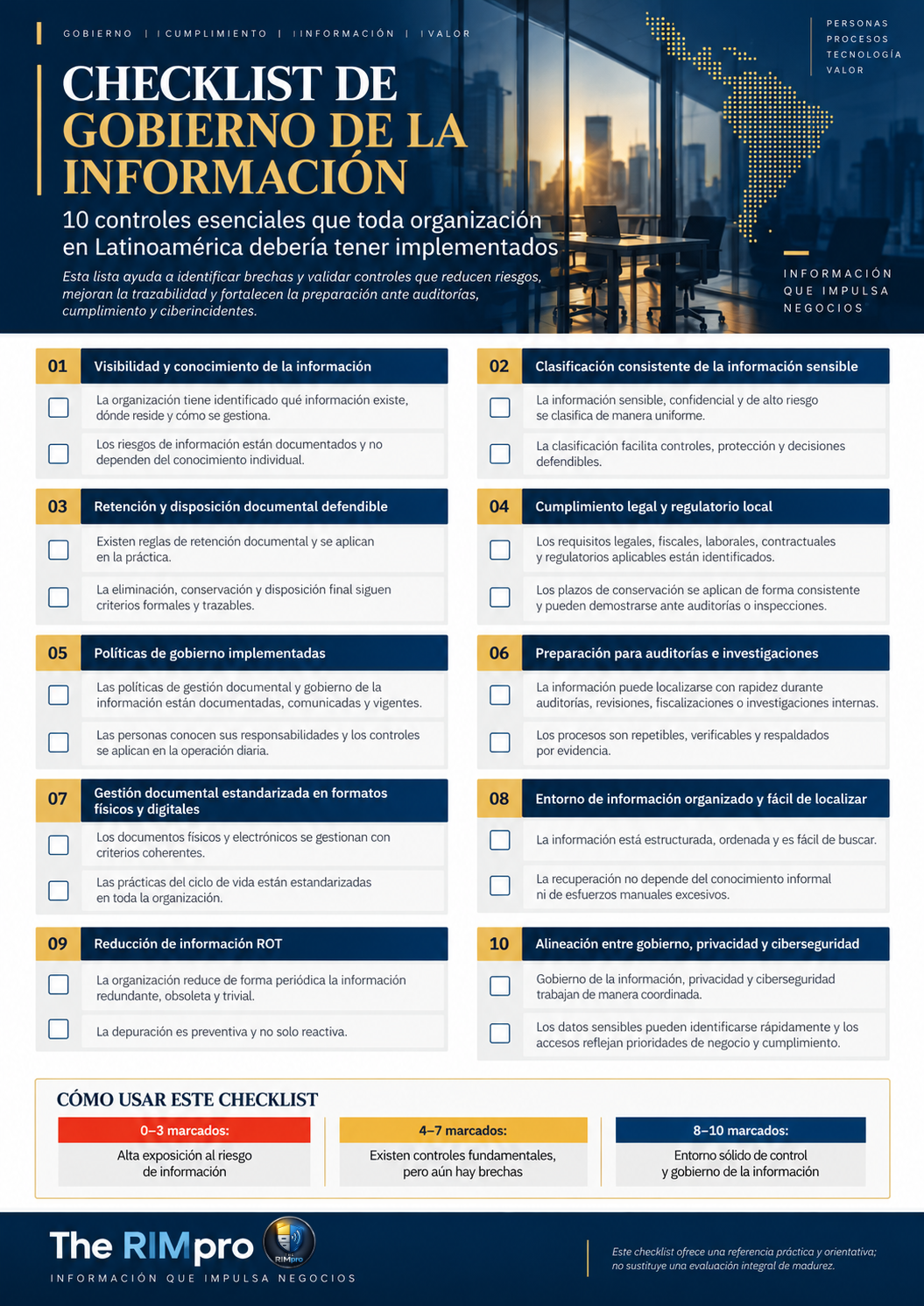
The ten controls: English reading guide
- 1. Information visibility: know what exists, where it resides and how it is managed; document information risks.
- 2. Consistent classification: identify sensitive, confidential and high-risk information so that protection and decisions follow clear rules.
- 3. Defensible retention and disposition: apply retention rules and keep formal, traceable evidence of destruction, preservation or transfer.
- 4. Local compliance: identify applicable legal and regulatory requirements and demonstrate how retention periods are applied.
- 5. Implemented policies: maintain current, communicated policies, defined responsibilities and evidence of daily application.
- 6. Audit and investigation readiness: locate relevant information promptly through repeatable, verifiable processes.
- 7. Consistent physical and digital records practices: apply coherent criteria and standardize lifecycle activities.
- 8. Organized, findable information: support reliable retrieval without depending on an individual's memory or excessive manual effort.
- 9. Reduced ROT information: routinely review redundant, obsolete and trivial content, respecting retention rules and holds.
- 10. Coordinated governance, privacy and cybersecurity: identify sensitive data and align access with business and compliance needs.
Start with one process and a measurable improvement
For Latin American organizations, the practical next step is to choose one critical process and connect its obligations, records, people and systems. Review the checklist with evidence, select the highest-priority gaps and assign an owner and completion date to each action.
An EDRMS delivers value when the organization can consistently find, protect, retain and recover the records it needs. The RIMpro can help assess an existing implementation or define requirements and an adoption plan for a new one. Bring one critical process and your checklist findings to a consultation to identify the next steps.
Sources and further reading
This article was adapted and expanded for The RIMpro from the original article published on LinkedIn ↗.