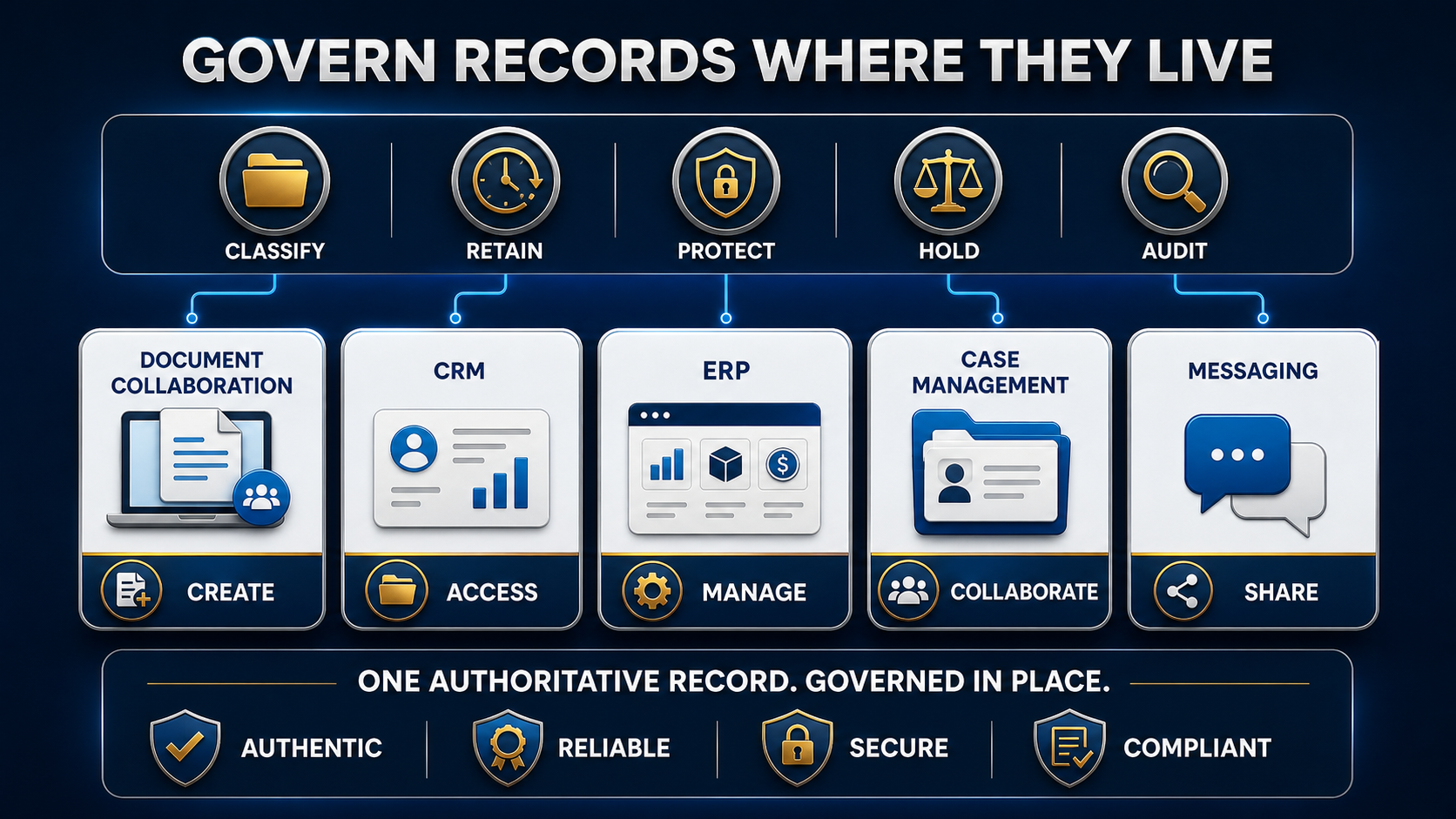
For decades, electronic records management followed a repository-first model: move records out of the systems where they were created and into a dedicated Electronic Records Management System (ERMS) for long-term control. That approach worked when most electronic records were office documents stored on shared drives. Today, business evidence is distributed across cloud collaboration platforms, customer relationship management systems, enterprise resource planning applications, case-management tools, messaging environments, and industry-specific systems. Transferring every record to one repository is no longer realistic—or always desirable. In-place records management offers a different operating model: bring governance to records in the systems where people create, receive, and use them.
From repository-first to governance-first
In-place records management allows digital records to remain in their native business applications while governance controls are applied through metadata, configuration, automation, policies, and connected governance technologies. Depending on the platform, those controls can include classification, retention, legal holds, access restrictions, disposition, version history, and audit evidence.
A contract in Microsoft 365, a customer interaction in Salesforce, a transaction in an ERP platform, or a case file in a line-of-business application can therefore be governed without creating an unnecessary copy solely for records management. The specific controls will vary by platform, but the principle is consistent: govern the authoritative record where its business context is strongest.
This is not an argument against every transfer, archive, or dedicated repository. It is an argument against making relocation the automatic answer for every digital record.
Email attachments create invisible security and records risks
One of the most practical benefits of in-place records management is reduced reliance on email attachments. Email became the default way to share documents, leaving copies scattered across mailboxes, personal drives, downloads folders, and unmanaged storage. Each attachment creates another version whose authority, sensitivity, and retention status may be unclear.
That duplication has consequences. An attachment may remain after the authoritative record has been updated or defensibly disposed of. It may expand the volume that must be reviewed for an access request, audit, investigation, or legal discovery. It may also carry personal, confidential, or security-sensitive information beyond the access controls protecting the original.
Secure links offer a better default. People can collaborate on a single governed version while permissions, classification, retention, legal holds, version history, and audit trails remain connected to the record. Links are not a complete security control—organizations still need appropriate sharing settings, identity controls, and monitoring—but they make a single source of truth far easier to maintain.
As cloud collaboration and artificial intelligence become routine, emailing attachments should increasingly be treated as a legacy habit, not a modern information-governance practice.
Business context is part of the record
A record is more than its content. Its evidential value also depends on the context that shows who created it, when and why it was created, how it changed, what process it supported, and how it relates to other records.
Keeping a record in its native environment can preserve the characteristics that make it trustworthy. ISO 15489-1 emphasizes authenticity, reliability, integrity, and usability as essential characteristics of records. Moving content to another repository can be appropriate, but a poorly designed transfer may weaken or disconnect the contextual information that supports those qualities.
- Original metadata and provenance
- Version history and change evidence
- Audit trails and user activity
- Relationships with cases, transactions, or other records
- Business-process and decision context
- Security classifications and access history
Better compliance without burdening users
Traditional approaches often asked employees to identify records manually, declare them, and transfer them to a separate repository. Those extra steps competed with operational work and produced inconsistent capture.
In-place controls can embed recordkeeping into everyday processes. Rules can recommend or apply classifications, calculate retention periods, preserve content under legal hold, capture required metadata, and initiate disposition review with less manual effort. People should still understand their responsibilities, and automated decisions require oversight, but good design moves the burden from individual memory to repeatable controls.
The result is not governance without users. It is governance designed around how users actually work.
Reduce duplication, cost, and architectural complexity
Copying records into separate repositories increases storage, creates synchronization problems, multiplies integration points, and can produce competing versions of the same evidence. Managing suitable records where they already live can reduce that overhead.
The business case extends beyond storage savings. Fewer migrations, less duplicate processing, simpler information flows, and clearer ownership can make governance more sustainable. Reducing redundant copies also limits the information footprint exposed to cyber incidents, privacy breaches, discovery, and unnecessary retention.
- Fewer uncontrolled copies and duplicate records
- Less dependence on large migration projects
- Simpler architecture and fewer synchronization failures
- More consistent permissions and retention controls
- A smaller information footprint to secure and review
Preserved context supports more trustworthy AI
Artificial intelligence is only as dependable as the information and controls surrounding it. Enterprise search, copilots, and large language models benefit from metadata, provenance, relationships, permissions, and current business context. An isolated copy stripped from its operational environment may be less useful—and more difficult to interpret safely—than the governed source record.
In-place records management can support responsible AI by preserving context and access controls close to the source. It also helps organizations identify authoritative content, limit obsolete or duplicated material, and apply retention and disposition rules to the information available for retrieval. Records governance does not make AI accurate by itself, but weak records governance will undermine AI assurance.
Use a hybrid model when native systems are not ready
Not every business application can enforce a retention schedule, preserve an immutable audit trail, manage legal holds, export records with their metadata, or execute defensible disposition. Some systems will be replaced; some cannot support long retention periods; and some records must be transferred to an archival or preservation environment.
For those situations, a controlled transfer to an ERMS, archive, or preservation repository remains appropriate. The right strategy is often hybrid: manage records in place where the native platform can meet the requirements, and transfer them when legal, operational, preservation, or technology risks demand it.
Before choosing the model, assess the system—not just the content. Confirm ownership, metadata quality, access controls, retention capability, hold behaviour, audit evidence, exportability, continuity arrangements, and the ability to dispose of records completely and defensibly.
A note for Microsoft 365 and SharePoint teams
In this article, in-place records management describes the broader operating model of governing records in their native systems. It should not be confused with the older SharePoint feature that Microsoft also called In-Place Records Management. Microsoft ended support for several of those legacy SharePoint capabilities in April 2026 and directs Microsoft 365 customers to Purview Data Lifecycle Management and Purview Records Management.
The distinction matters: a retired product feature does not invalidate the governance model. It reinforces the need to implement that model with current, supported capabilities and a clear architecture.
International standards support records management by design
In-place records management aligns with the direction of recognized standards when it is implemented with appropriate controls. ISO 15489-1:2016 establishes the concepts and principles for creating, capturing, and managing records in any business or technological environment. ISO 16175-1:2020 provides functional requirements for applications that manage digital records—including applications whose primary purpose is another business function. ISO/TS 16175-2:2020 provides implementation guidance, while ISO 30301:2019 connects records controls with organizational objectives through a management-system approach.
The Records Continuum Model offers a complementary way to understand this shift: records participate in an ongoing continuum of creation, capture, organization, and broader use rather than moving through a series of isolated stages. The common lesson is that recordkeeping requirements should be designed into systems and processes from the beginning.
A practical roadmap for governing records in place
Start with a high-value business process, not with every application at once. Bring records, security, privacy, legal, technology, and operational owners together to test whether the native system can meet the organization’s requirements.
- Inventory the systems that create authoritative business records
- Map record classes, retention rules, legal holds, privacy needs, and security classifications
- Evaluate each platform’s native controls, integrations, audit evidence, and export capabilities
- Replace routine attachments with governed links and configure secure sharing defaults
- Automate classification and retention where confidence is high, with accountable human oversight
- Test search, access, legal hold, disposition, export, business continuity, and preservation end to end
- Measure duplicate copies, attachment use, retrieval time, exceptions, and user effort
Move governance to where records live
The question is no longer whether digital records should be governed. It is where and how that governance should operate. For many organizations, the strongest answer is to apply controls in the systems where records retain their richest context and where people already do their work.
Done well, in-place records management preserves authenticity, reduces duplication, improves compliance, strengthens security, supports responsible AI, and connects records management with the wider information-governance ecosystem.
The future of records management is not about moving every record. It is about moving governance to where records live.
Has your organization adopted an in-place or hybrid records strategy? Share your perspective, or book a 30-minute conversation with The RIMpro to assess one high-value system and identify a practical starting point.
Sources and further reading
- ISO 15489-1:2016 — Records management: Concepts and principles ↗
- ISO 16175-1:2020 — Functional requirements for software that manages digital records ↗
- ISO/TS 16175-2:2020 — Guidance for selecting and implementing records software ↗
- ISO 30301:2019 — Management systems for records ↗
- Microsoft Purview — Records management ↗
- Microsoft — Use Purview instead of older SharePoint records features ↗
This article was adapted and expanded for The RIMpro from the original article published on LinkedIn ↗.